

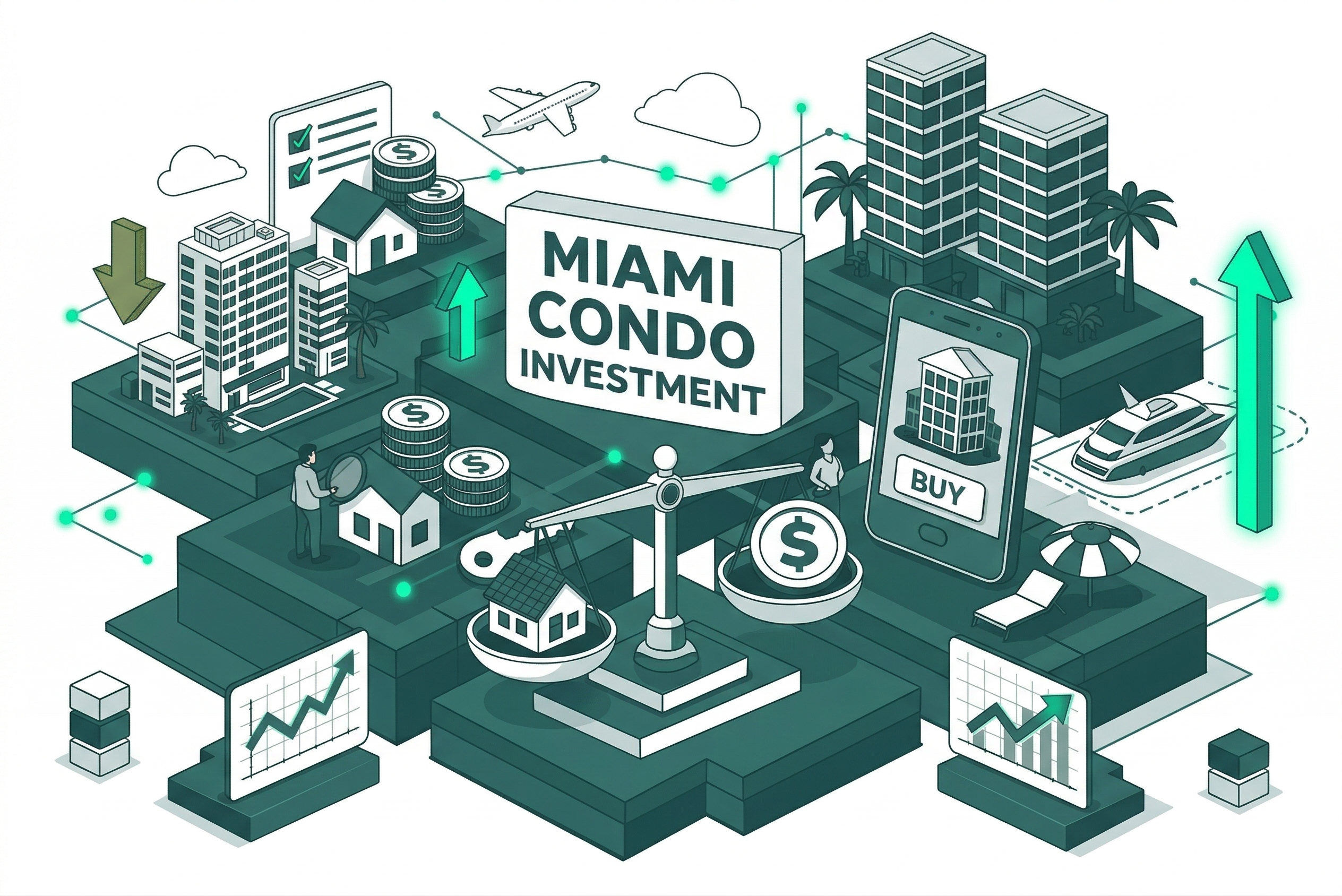
If you’re purchasing investment property in Miami, the condo market remains one of the most compelling entry points available to U.S. and international investors right now. Tenant demand is strong, global buyer interest is consistent, and well-located units stay in short supply, all of which make a compelling case for moving decisively and moving smart. Whether you’re building a portfolio or acquiring your first income-producing asset, the fundamentals here are hard to ignore.
The reality is that most buyers don’t stumble on the deal itself. They stumble on the process: wrong financing structure, skipped due diligence, or HOA rules they never read until after closing. These are fixable problems, but only if you address them in the right order. At Associates Realty, we’ve coordinated Miami condo acquisitions for investors for many years, and the sequence below reflects exactly how we walk clients through each stage, from market selection to the day rent starts hitting their account.
Purchasing Investment Property: Financing Your Miami Condo
Conventional loans vs. DSCR loans: which fits your situation
Most buyers entering the Miami condo market start with a conventional loan, and that makes sense for borrowers with strong personal income and clean tax returns. Conventional financing through Fannie Mae and Freddie Mac offers competitive rates and predictable terms for 1-4 unit properties (review typical Fannie Mae and Freddie Mac eligibility standards). The trade-off is that qualification depends heavily on your debt-to-income ratio and documented income, which can be restrictive for self-employed investors or those with complex financials.
DSCR loans have become a serious alternative for those purchasing investment real estate, particularly for experienced investors who prefer to qualify based on the property’s rental income rather than personal tax returns. The lender evaluates whether the projected rent covers the debt service, typically requiring a ratio of 1.0 or higher. This structure suits investors who are building a portfolio and don’t want each acquisition scrutinized through their personal financial picture.
Down payment requirements and condo-specific lending rules
Investment condos typically require 20-25% down on conventional financing, and that’s before you factor in the warrantability question. Fannie Mae and Freddie Mac only back loans on condos that meet their eligibility standards, and a notable share of Miami buildings don’t qualify, a pattern well-documented among Florida’s high-concentration investor and pre-construction tower inventory. A condo becomes non-warrantable when it carries high investor concentration, pending litigation against the HOA, low owner-occupancy ratios, or short-term rental operations baked into the building’s structure.
When a building is non-warrantable, your investment property financing options shift to portfolio loans or non-QM products, which typically carry higher interest rates, larger down payment requirements, and stricter underwriting. Buyers should check a building’s Condo Project Manager (CPM) status with Fannie Mae before making an offer, not after. Discovering a non-warrantable designation at the loan commitment stage kills timelines and deals. For a practical overview of investment property loans and how lenders treat rental units, review lender guidance before you submit an offer.
What to budget beyond the down payment
Investment property loans carry an interest rate premium over primary residence loans, often in the range of 0.5% or more, though the spread varies by lender and borrower profile and can run higher depending on loan type. That premium compounds meaningfully over a 30-year term. Florida closing costs run 2-5% of the purchase price for financed transactions, covering documentary stamp taxes ($0.70 per $100 of purchase price), lender’s title insurance, origination fees, appraisal, and recording costs. On a $450,000 condo, that’s $9,000 to $22,500 in cash due at closing, on top of your down payment.
Lenders often require reserve accounts as well, commonly measured in months of mortgage payment, with requirements varying by lender and loan program. Go into your first investment property acquisition with a realistic cash budget, not an optimistic one. Buyers who arrive at the closing table underfunded create problems that are expensive to fix.
Picking the Right Miami Condo for Rental Income
Neighborhoods with consistent rental demand
Brickell consistently delivers the strongest yields among Miami’s core submarkets, averaging 6-8% gross on smaller units based on recent transaction data. The neighborhood draws white-collar tenants and corporate relocations, which creates stable, repeatable demand. How to Buy a Condo in Brickell Miami 2026 Guide is a useful primer if you’re focused on that submarket. Edgewater offers an accessible price point with yields in the 6.7-7.1% range and benefits from its proximity to Brickell and waterfront positioning. For investors focused on long-term leases and lower turnover, Doral and Kendall provide steady tenant bases tied to the airport corridor and family demographics.
Wynwood trades on cultural appeal and appreciation potential, but gross yields run closer to 5.2%, the lowest among the primary investment submarkets. That’s not a disqualifier, but it does mean your return thesis needs to lean on equity growth rather than immediate cash flow. The Wynwood buyer typically has a longer time horizon and prioritizes capital appreciation over near-term income. For national comparisons of rental yields, consult market-level data when you finalize your underwriting assumptions.
HOA rules that can make or break your buy-to-let property
Miami condo associations vary dramatically in how they handle rentals. Some buildings cap the percentage of units that can be rented simultaneously, often at 20-50% of total units. Others impose minimum lease terms of six or twelve months, which eliminates any short-term rental income strategy entirely. Reviewing the HOA documents before making an offer is not optional. It belongs in your evaluation checklist before you spend a single dollar on inspections or appraisals.
Post-Surfside legislation has added another layer to HOA finances. Florida now requires associations to fully fund reserves for all major structural components identified in a Structural Integrity Reserve Study, and those contributions cannot be waived by membership vote. Buildings that were previously underfunded are now facing significant catch-up assessments. A buyer who closes on a unit in an underfunded building could face significant special assessments within months of closing, depending on the building’s reserve shortfall and assessment schedule. For the legal context behind these changes, review the HB 913 key updates for post-Surfside legislation, and consult our guide on Miami Condo Laws 2026: What Buyers Must Know before you proceed with an offer.
What separates a good condo deal from a costly one
The best investment condos in Miami share a few consistent traits: unit size that justifies the market rent without requiring premium finishes, building amenities that attract reliable tenants, dedicated parking (which commands a meaningful rent premium in urban buildings), and proximity to employment corridors. A $450,000 studio in Brickell with parking and walkable access to Financial District employers will outperform a $400,000 two-bedroom in a secondary location with high HOA fees and no covered parking. Look beyond the listing price and evaluate the full income picture before comparing deals.
Running the Numbers Before You Make an Offer
How to calculate cap rate and cash flow on a Miami condo
Cap rate measures a property’s standalone performance independent of financing. The formula is simple: net operating income divided by purchase price. A Brickell studio purchased for $450,000 generating $28,000 in annual NOI produces a 6.2% cap rate. NOI itself is gross rental income minus operating expenses, which for Miami condos includes HOA fees, property taxes, insurance, and maintenance reserves but excludes your mortgage payment.
Cash flow is the metric that tells you what actually lands in your account. It’s NOI minus annual debt service. A property with a strong cap rate and heavy financing can produce thin or negative cash flow, particularly in a high-interest-rate environment. Model both numbers before you make an offer, and stress-test the cash flow with a vacancy assumption of at least 5-7%.
Investment property ROI metrics: cash-on-cash return in Miami
Cash-on-cash return divides your annual cash flow by your total cash invested, which includes your down payment plus closing costs. Using the Brickell example above: if you put $112,500 down (25%) plus $18,000 in closing costs for a total cash investment of $130,500, and your annual cash flow after debt service is $8,000, your cash-on-cash return is approximately 6.1%. That’s a reasonable result for a coastal urban market where appreciation has historically run 3-5% annually.
Miami is not a maximum cash flow market, and buyers who enter expecting Midwest-style yields will be disappointed. What Miami offers is a combination of stable rental demand, consistent appreciation, and global liquidity when you decide to sell. That trade-off makes sense for the right investor profile.
Operating expenses investors consistently underestimate
The line items that quietly erode Miami condo returns deserve honest attention in your pro forma. HOA fees in mid-range high-rises run $600-$1,200 per month, and luxury towers can exceed $1,900. Property management fees typically land at 8-10% of gross rent for a local manager. South Florida insurance premiums have risen sharply over the past three years, with industry data pointing to continued pressure on costs across the region. Add a maintenance reserve of 5-10% of gross rent and you have a realistic operating expense picture. Skip any of these in your initial projections and you’ll build a model that looks good on paper and underperforms in reality.
Purchasing Investment Property: Due Diligence You Can’t Skip
Physical inspections and what Miami’s climate demands
A standard home inspection is not sufficient for Miami condos, especially in older or oceanfront buildings. You need specific attention to HVAC systems, which work hard in South Florida humidity and fail predictably when deferred. Moisture intrusion, balcony and facade conditions, and any deferred building maintenance are critical review items. Structural integrity assessments became standard after the Surfside collapse and should be treated as non-negotiable, regardless of building age.
Reviewing HOA financials and the reserve fund
Healthy HOA finances look like this: a reserve fund adequately funded according to SIRS recommendations, no pending litigation against the association, a stable fee history without dramatic recent increases, and no looming special assessments buried in the board meeting minutes. Request the last two years of financial statements and the most recent reserve study. If the association is resistant to providing these documents, that resistance is itself a red flag worth taking seriously.
Title, liens, and red flags to catch before you close
A thorough title search reveals the encumbrances common in Miami condo transactions: unpaid HOA assessments, mechanic’s liens from recent building work, delinquent property taxes, and ownership disputes. Title insurance protects you against issues that surface after closing and is essential, not optional. The red flags that justify renegotiating or walking away include unexplained liens, sellers who refuse to produce HOA documents on request, and inspection findings suggesting undisclosed water damage. These aren’t negotiating tactics. They’re legitimate reasons to pause.
How the Miami Condo Closing Process Works
From executed contract to the closing table
Florida’s standard purchase timeline begins with an escrow deposit, commonly around 10% of the purchase price, though timing and amounts vary by contract and are often negotiable, typically due within a few business days of contract execution. The inspection period, often ranging from seven to fifteen days depending on contract terms, gives you the right to cancel and recover your deposit if findings justify it. The loan commitment deadline follows, and then the final walkthrough before closing. Miami transactions frequently involve foreign national buyers, wire transfer protocols, and international title coordination, which makes local advisory support especially valuable for first-time investment buyers who aren’t familiar with Florida’s transaction process.
Closing costs and what each line item covers
Florida’s documentary stamp tax on the deed runs $0.70 per $100 of purchase price, paid by the buyer. On a $450,000 condo, that’s $3,150 before title insurance, lender origination, recording fees, and prepaid items like the first year of insurance. Those additional items add up faster than most buyers expect. Note that FIRPTA withholding obligations can apply when a seller is a foreign national, a detail that requires coordination with a qualified closing attorney familiar with IRS requirements. Budget 3-5% of the purchase price in total closing costs for a financed transaction and don’t let optimism compress that number.
Post-closing: getting your condo rent-ready
Closing day is not the finish line. The steps immediately following closing determine how quickly the property generates income. You need to set up HOA access, navigate any lease approval processes the association requires, prepare the unit with fresh paint and functional appliances, and secure a property management partner if you’re not managing locally. Each of these tasks has a timeline, and delays in any one of them push back your first rent collection.
Associates Realty coordinates this entire post-closing preparation as part of its end-to-end advisory service. From connecting clients with our vetted vendor network for unit prep to identifying the right property manager for their tenant profile, we turn a closed deal into a cash-flowing asset without the owner managing every vendor call from out of town. For international buyers and investors who aren’t based in Miami full-time, that coordination is the difference between a smooth start and a frustrating first quarter.
The Roadmap Is Clear: Now Execute It
Acquiring a Miami investment condo is one of the stronger long-term plays available to both U.S. and international investors. The steps are clear: structure your financing correctly before you start shopping, choose a building with workable HOA rules and healthy reserves, run your numbers honestly with realistic expense assumptions, perform thorough physical and financial due diligence, and follow a disciplined closing process that accounts for Florida’s specific requirements.
The investors who succeed here don’t just buy well. They close well, set up well, and stay on top of the asset from month one. That discipline is what separates a high-performing rental property from one that looks good in a spreadsheet and creates headaches in practice.
If you’re purchasing investment property in Miami, connect with an Associates Realty agent who specializes in this market. We’ve handled every stage of this process for a long time. How to Sell Your Miami Home in Today’s Market is one of the resources we use to help investors plan exit strategies; reach out today and we’ll map out exactly what yours looks like.
Leave a Reply