

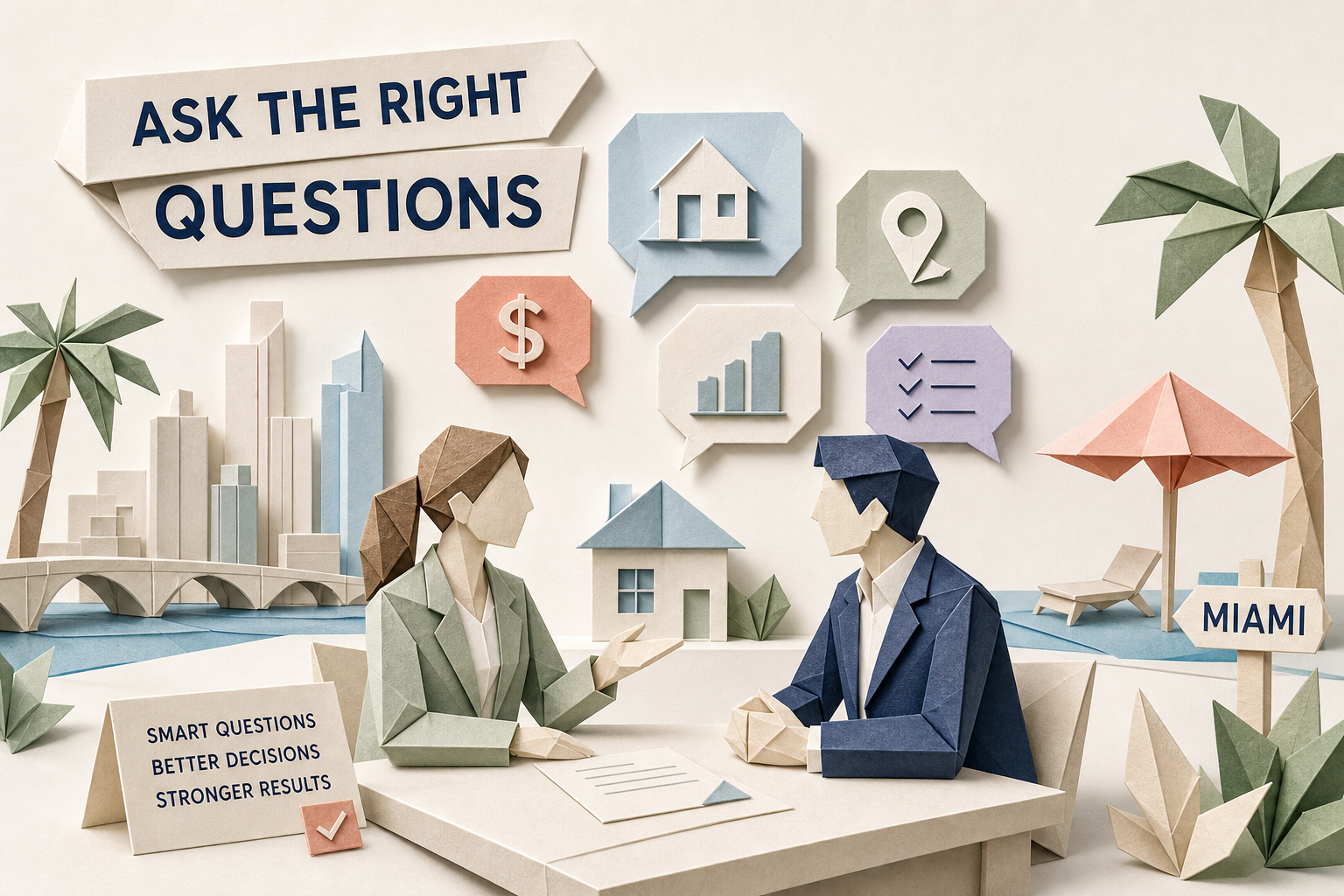
Finding the right real estate agent in Miami is one of the most consequential decisions you’ll make in the city’s market. Miami plays by its own rules: international buyer demand runs seven times the national average, neighborhood dynamics shift block by block, luxury condo presales come with their own due diligence timelines, and the 2024 NAR settlement rewrote how buyers and agents formally agree on compensation before a single showing. Choosing the wrong agent here doesn’t just mean a frustrating experience. It can mean a missed deal, an overpaid closing, or a property that sits on the market while comparable units move in weeks.
Knowing what to ask puts you in control before you ever sign anything. Buyers and sellers who walk into agent conversations with the right questions tend to get better outcomes. They expose agents who look polished on paper but lack real neighborhood depth. They surface the contract terms that matter. They build relationships with advisors who genuinely deliver, not just transact. The framework below gives you exactly that: a practical, specific guide for vetting, interviewing, and selecting the Miami real estate professional who’s right for your situation, whether you’re searching for a Miami condo specialist, evaluating Miami luxury real estate agents, or simply trying to find a realtor in Miami who knows your target neighborhood cold.
How to verify a Miami real estate agent’s credentials before your first call
Checking license status through official Florida channels
Before you review a single listing or schedule a showing, spend two minutes on MyFloridaLicense.com, the Florida Department of Business and Professional Regulation’s (DBPR) verification portal. Search the agent’s name, select “Real Estate” as the license category, and you’ll see their active license status, expiration date, associated brokerage, and any disciplinary actions on record. This information is state-regulated and current, not something agents self-report on a bio page.
Miami’s competitive market attracts agents from across the state and beyond, and license problems don’t always announce themselves. An expired license, a lapsed status, or a prior disciplinary action tells you something critical before you invest time in the relationship. This step costs you nothing and protects you from a class of problems that are entirely avoidable.
Professional designations worth paying attention to
Beyond basic licensing, designations signal how seriously an agent has invested in their craft. For buyers, the ABR (Accredited Buyer’s Representative) shows specific training in buyer advocacy. The CRS (Certified Residential Specialist) indicates advanced residential transaction experience. For anyone working with international buyers or sellers, the CIPS (Certified International Property Specialist) is the most directly relevant credential, connecting agents to a global network of 3,500+ professionals and equipping them for cross-border transaction nuances that are genuinely common in Miami deals. Learn more about the Certified International Property Specialist (CIPS) program.
These designations aren’t on the DBPR portal; verify them through the agent’s brokerage or the National Association of Realtors’ member directory. Treat them as one signal among many, not a guarantee of performance, but an agent who has invested in advanced education is typically more serious about their practice than one who hasn’t.
Why neighborhood expertise matters more than a general Miami license
What a Brickell or Coral Gables specialist knows that a generalist doesn’t
Miami isn’t one market. Brickell operates as a dense, high-rise condo environment where resale prices per square foot range from roughly $525 for older vintage units to $657 or higher for general resale condos, and where specific buildings carry investor restrictions or pending special assessments that an outsider won’t know. Miami Beach commands waterfront premiums that require granular comp analysis at the building level. Coral Gables has historic preservation rules and deed restrictions that affect renovation scope and resale value. Wynwood’s investment profile is still evolving, with commercial conversion activity and zoning overlays that demand a specialist who tracks the neighborhood monthly. For a focused look at Brickell market dynamics, see our Miami Real Estate Market Trends 2026 Forecast.
A Miami realtor who has never sold a unit in Brickell won’t know which towers have HOA financial health issues, which buildings are past their reserve study window, or which developments have been flagged for structural assessments since the Surfside collapse reshaped condo disclosure requirements statewide. That knowledge gap has real dollar consequences for both buyers and sellers. For more on recent regulatory and disclosure changes affecting condos, review Miami Condo Laws 2026: What Buyers Must Know.
How to test a real estate agent in Miami during the first conversation
You don’t need to be an expert to test one. Ask directly: “What’s the average price per square foot in this building right now?” or “How many units have sold in this zip code over the last 90 days?” or “Are there any upcoming HOA special assessments in this complex I should know about?” An agent who knows their micro-market answers these questions quickly and specifically, often with data already pulled. An agent who hedges, generalizes, or promises to “get back to you” on neighborhood-specific questions is telling you something important about how they’ll perform when deal terms get real.
How Miami agent fees work in 2026 and what you’re actually paying for
Commission rates after the NAR settlement and what’s negotiable
As of early 2026, the average total real estate commission in Miami sits at approximately 5.57%, split roughly as 2.75% to the listing agent and 2.82% to the buyer’s agent. These figures come from a February 2026 market survey and fall slightly below the national average of 5.70%. All rates are fully negotiable by law; no fixed standard exists. For a breakdown of typical commission rates in Miami, review the average real estate commission in Miami.
The 2024 NAR settlement reshaped the rules meaningfully for buyers. Sellers are no longer required to fund the buyer’s agent commission through the MLS. Instead, buyers now negotiate directly with their agent before touring properties, and that agreement must be in writing. Sellers can still offer to cover buyer-side costs through purchase negotiation, but it’s no longer an automatic built-in. Discount brokers and flat-fee alternatives exist and can reduce total costs, but they typically reduce service depth as well. If you’re evaluating those options, read a concise flat-fee vs. commission guide to understand trade-offs.
What “full-service” actually includes and why it matters at closing
There’s a significant gap between an agent who manages paperwork and coordinates showings and one who provides genuine end-to-end advisory support. Full-service in Miami should include a data-backed comparative market analysis, staging coordination, access to vetted licensed contractors for pre-listing preparation, professional media production (photography, drone footage, virtual tours), and real support after closing if renovation or transition coordination is needed.
This is exactly the model Associates Realty is built around: a single advisor coordinating a fully licensed and insured professional network across every phase, from acquisition through post-closing, backed by 20+ years of Miami market experience. The distinction matters because a transaction-only agent leaves you assembling contractors, inspectors, attorneys, and photographers on your own, often under time pressure and without vetted relationships.
Top questions to ask your real estate agent in Miami before signing anything
Questions that reveal their actual track record in your area
Start with volume and specificity together: “How many transactions did you close in this neighborhood in the past 12 months?” and “What was your average list-to-sale price ratio?” These two questions together reveal whether an agent is actually active in your target area or just licensed to work there. Pair them with: “Can you show me three recent comps you used to price a similar property?” A strong agent produces this data immediately, not as a follow-up task.
Volume alone doesn’t tell the full story. An agent closing 60 transactions across all of Miami-Dade works very differently from one closing 20 within Coral Gables specifically. The first is running a high-throughput operation; the second is running a neighborhood practice. Depending on your situation, one model may serve you better than the other, but you should know which one you’re hiring.
Questions about their team, tools, and transaction process
Ask: “Who handles the transaction if you’re unavailable?” and “Do you have a vetted network of inspectors, attorneys, and contractors you work with regularly?” These questions reveal whether you’re hiring an individual who operates alone or a coordinated team with real support infrastructure. In Miami, where international buyers introduce foreign title complexities, condo due diligence adds legal layers, and post-hurricane inspection timelines can compress deal windows, working with an agent who has no backup or vendor network creates unnecessary risk.
Also ask: “What does your communication process look like from offer to closing?” You’re not looking for a generic answer about “staying in touch.” You want to know their system: how often they update you, through what channel, who’s responsible for each step, and what happens if a contingency deadline approaches and they’re managing 10 other transactions simultaneously.
Questions to ask before you sign a buyer or listing agreement
Before committing to any agreement, clarify the contract’s duration, exclusivity clauses, early termination conditions, and exactly how the agent’s fee is structured if the deal falls through without closing. Watch specifically for post-termination commission rights, which can obligate you to pay the agent months after the relationship ends if you buy a property you saw during the agreement period. Dual agency disclosures also matter: if the agent or their brokerage represents both sides of a transaction, that’s a conflict worth understanding before it arises, not after.
Red flags that tell you to keep looking
Vague answers on pricing, comps, and market conditions
An agent who can’t produce a clear comparative market analysis during an initial consultation, or who gives you a price range without supporting data, is either underprepared or running a volume model that doesn’t prioritize your transaction. Miami’s MLS data is detailed and current. There’s no legitimate reason for vagueness on recent sales, days on market, or price-per-square-foot trends in a specific building. If an agent gives you ballpark figures without backup, treat that as a preview of how they’ll handle negotiations.
Pressure tactics, post-closing disappearance, and no vendor network
Flag agents who manufacture urgency without market justification: “You need to offer today or this is gone” is sometimes true in Miami, but it requires actual evidence, not pressure tactics. Equally important is what happens after closing. Agents who go quiet once the deal closes leave buyers and sellers to handle renovation coordination, contractor sourcing, and property management transitions entirely on their own.
For buyers who plan renovations or sellers prepping a property for listing, post-closing support isn’t a bonus feature. It’s part of what working with a Miami real estate agent should deliver. If an agent can’t name their preferred title attorney, inspector, or licensed contractor when you ask, that gap in their network becomes your problem during the transaction. Real advisory relationships feel like long-term partnerships, not one-time transactions.
Where to research and compare Miami realtors online before reaching out
Review platforms that give you real signal
The most reliable starting points for researching Miami real estate agent reviews are Google Business Profile, Zillow, Realtor.com, and MIAMI REALTORS’ affiliated tools like RealSatisfied and RateMyAgent. Google surfaces high-visibility reviews with named clients and is the first check most people do. Zillow hosts over 34,000 Miami agent profiles with skill-level breakdowns across negotiation, local knowledge, and responsiveness. Realtor.com ties profiles to NAR membership for added credibility. RateMyAgent specifically verifies reviews against closed transactions, which removes the inflated self-promotion common on general review sites.
RealTrends is valuable for sales volume rankings, but it measures production, not client experience. Use it alongside review platforms to get both perspectives. Local brokerage pages often embed the same reviews you’d find on third-party platforms, but without the independent aggregation that makes comparison fair.
The metrics that actually matter when comparing the best realtors in Miami
Focus on agents with a minimum of 20 verified reviews, with the majority from the past 12 to 24 months. A 4.8-star average from 8 reviews two years ago tells you less than a 4.6-star average from 45 reviews over the past year. Read full review text, not just aggregate scores. Client comments reveal patterns that star ratings compress: repeated mentions of communication problems, missed deadlines, or lack of local knowledge show up in the text long before they drag down an overall average.
When you’ve built a shortlist from these sources, use the interview questions above to narrow it further. The research phase tells you who’s worth calling. The conversation tells you who’s worth hiring.
The framework that protects your Miami transaction
The process is straightforward when you follow it in order. Verify credentials through official Florida channels first. Test neighborhood knowledge with specific questions during your first conversation. Understand the fee structure and what full-service actually includes. Ask direct questions about track record and team infrastructure. Watch for the red flags that signal a volume-first operation. Then use verified review platforms to build your shortlist before you make contact.
The right real estate agent in Miami isn’t defined by a license and a friendly pitch. They’re defined by verifiable results in your target neighborhood, a transparent process from first conversation through closing, and real support infrastructure behind them. Those qualities exist in the market, you just need to know how to find them.
If you want to work with a team that already operates this way, Associates Realty brings 20+ years of Miami market expertise, a vetted network of licensed and insured professionals, and a single-advisor approach that coordinates every stage of the process from acquisition through post-closing. Reach out to Associates Realty for a no-obligation consultation and see firsthand what working with the right real estate agent in Miami actually feels like. If you’re weighing timing and market conditions, also consider reading Is 2026 a Good Time to Buy in Miami?
Leave a Reply