

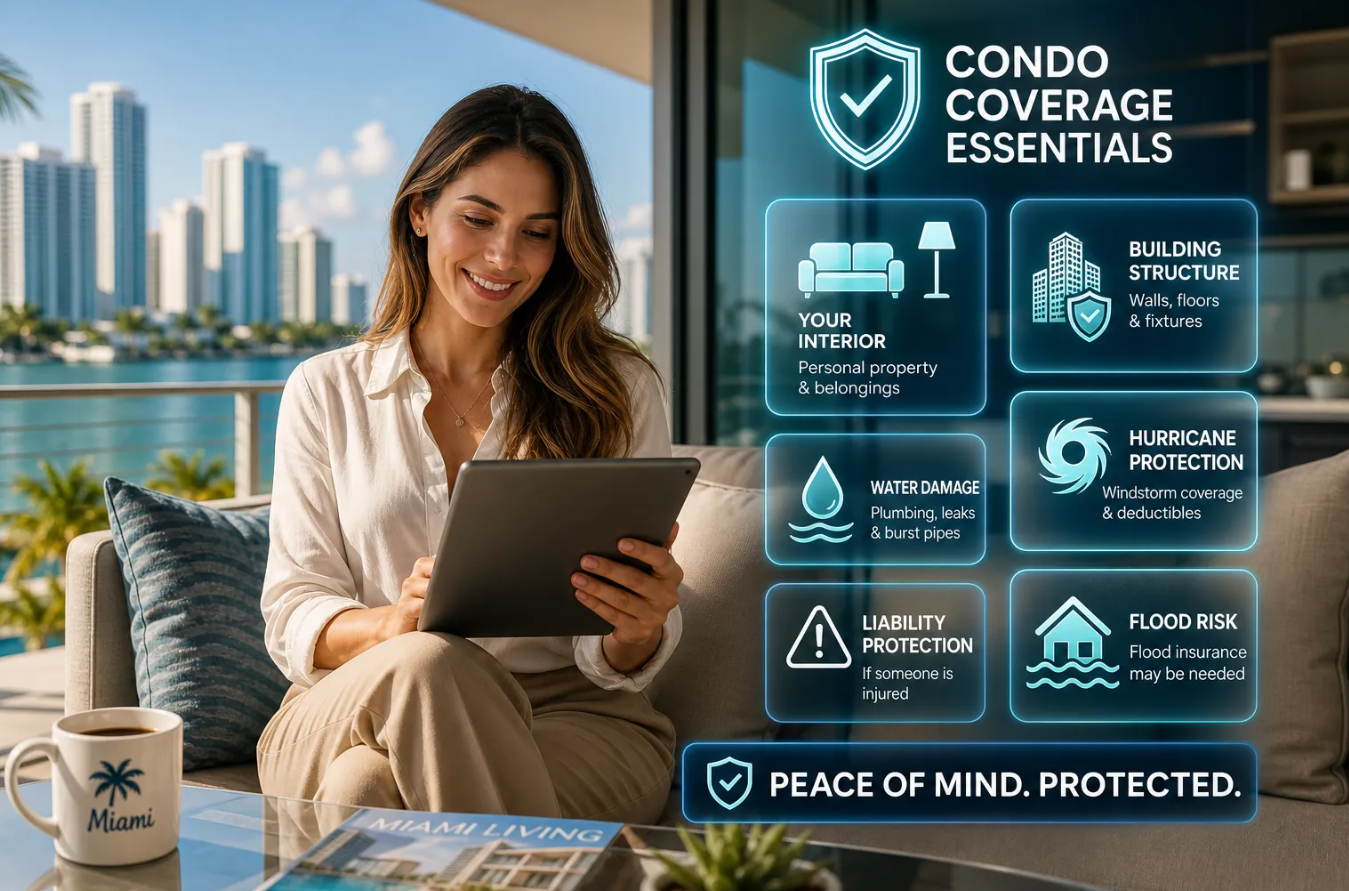
Many buyers ask what does condo insurance typically cover in Miami, and most assume the answer is simple: the building has insurance, the HOA pays for it, and that’s that. In reality, skipping the details on this question is one of the costlier mistakes a condo owner can make. Florida’s insurance landscape, hurricane deductibles, and flood exclusions create gaps that can leave owners holding five-figure bills they never anticipated.
Miami condo ownership involves two separate insurance layers working side by side. The condo association insures the building, the roof, and the shared spaces. You insure everything else. The owner’s piece of that equation is called an HO-6 policy, and understanding what it covers, what it doesn’t, and where the gaps live in a Miami-specific context is essential before you ever need to file a claim.
At Associates Realty, we build this conversation into the buying process early, because understanding what you’re buying includes understanding how it’s protected from day one. This guide walks through the full picture: the HO-6 basics, the master policy relationship, and the three gaps that catch Miami condo owners off guard most often.
What does condo insurance typically cover in Miami: HO-6 basics and unit-level protection
A standard Florida HO-6 policy is built around four core coverage areas. Each one addresses a different category of exposure that comes with owning the interior of a condominium unit. Knowing these four buckets helps you evaluate whether the limits on your current policy actually match your real risk. For a practical primer on these HO-6 coverages, see understanding what an HO-6 policy covers.
Interior walls, floors, and built-in finishes
The “walls-in” concept is central to how condo insurance works. Your HO-6 covers the physical interior of your unit: drywall, interior walls, ceilings, floor coverings, cabinets, fixtures, and any upgrades you’ve made since purchase. If a pipe bursts behind the wall and soaks the flooring, or a fire damages your kitchen finishes, the dwelling portion of your HO-6 is what pays for the rebuild.
The exact scope of this coverage depends heavily on how the condo association’s master policy is written. If the master policy is a bare walls-in form, your HO-6 needs to cover essentially every interior finish from the studs inward. If it’s an all-in policy, some original fixtures may already be covered. Knowing which type you’re dealing with is not optional, it’s covered in detail in the next section.
Personal property, liability, and loss of use
Beyond the unit’s physical interior, your HO-6 covers three additional areas that matter just as much in practice. Personal property coverage protects furniture, electronics, clothing, and appliances you own inside the unit. Personal liability covers legal costs and damages if a guest is injured inside your unit or if you’re found responsible for property damage to a neighbor. Most policies bundle legal defense costs into this coverage, which matters more than people realize once a lawsuit is involved.
Loss of use coverage pays for temporary housing, hotel stays, and meals while your unit is uninhabitable after a covered loss. If a fire on your floor renders the unit unlivable for three months, this coverage keeps you housed during repairs. One important note: default liability limits are often set around $100,000, consider whether that reflects your actual risk exposure given Miami’s cost of living and litigation environment. Many owners carry $300,000 or more based on personal circumstances and the value of their assets.
How the HOA master policy splits the responsibility
The condo association carries its own insurance policy separate from anything you buy. Understanding where that policy ends is the only way to know where yours needs to begin. This is where most condo buyers have a blind spot, and it’s worth getting specific.
What the association’s policy covers
The master policy covers the building structure, roof, exterior walls, common hallways, lobbies, elevators, pools, parking areas, and shared amenities. It also covers the association’s own liability for incidents that happen in those shared spaces. Unit owners have no direct claim on this policy. It exists to protect association property, not individual owners, and the coverage does not extend to your belongings, your interior finishes, or your personal exposure.
Bare walls-in vs. all-in: why this distinction changes everything
Florida master policies generally fall into two categories, and they produce very different results for unit owners. A bare walls-in policy covers the building shell and common elements only. Everything from the drywall inward, including paint, flooring, cabinets, countertops, and fixtures, is the owner’s responsibility. An all-in (sometimes called single-entity) policy extends coverage to original interior finishes inside the unit, but still excludes personal property, owner improvements, and personal liability.
The practical difference is significant. A bare walls-in owner needs HO-6 dwelling coverage that reflects the full cost to rebuild and finish the unit’s interior. An all-in owner may carry less dwelling coverage but still needs full personal property and liability limits. Owners who discover which type their HOA carries only after a loss, when a claim gets denied, are in a difficult position. Request the association’s declarations page and insurance certificate before closing, not after.
Hurricane and wind damage: the deductible most Miami owners underestimate
Wind and hurricane coverage works differently than most property owners expect in Florida. A 5% deductible on a $300,000 unit means $15,000 out of pocket before coverage applies, an exposure most buyers don’t price in when they’re comparing policies.
How Florida’s hurricane deductible actually works
In Florida, hurricane deductibles are not flat dollar amounts on most policies above a certain value threshold. They are a percentage of the insured structure value, typically 2%, 5%, or 10%. For policies with insured limits at or above $250,000, insurers are not required to offer a flat $500 option, which surprises many buyers accustomed to standard home insurance terms. For the state’s official explanation of how hurricane deductibles are applied, see Florida’s hurricane deductible guidance.
At the higher end, properties insured between $1 million and $3 million may only be offered 3%, 5%, and 10% options. Properties above $3 million may only see 5% and 10%. The deductible is applied per hurricane, not per policy period, so back-to-back storms can create two separate deductible obligations in the same season.
When the association’s deductible becomes your bill
Here’s the scenario most unit owners don’t see coming. If the building takes hurricane damage and the master policy’s deductible isn’t covered by association reserves, the HOA can issue a special assessment to every unit owner. In a Miami high-rise with a $2.5 million master policy deductible split among 210 units, each owner receives a bill around $12,000. That amount is due regardless of whether your own unit had any damage. This is exactly where loss assessment coverage becomes essential.
What does condo insurance typically cover in Miami when it comes to flood? Not what you think.
Standard HO-6 policies cover sudden internal water damage from burst pipes or appliance failures. They do not cover flood. In Miami, where storm surge, heavy rainfall, and overflowing waterways are consistent seasonal risks, that distinction has real financial consequences.
Why the HO-6 doesn’t cover rising water
Flood damage from any external water source is excluded from nearly every standard condo policy in Florida. The HO-6 covers a burst pipe inside your unit. It does not cover water that enters from outside following a hurricane, a storm surge event, or heavy runoff. Unit owners who carry no separate flood policy face paying for interior repairs, personal property losses, and temporary housing entirely out of pocket after a flood event, regardless of how well-insured the building itself may be.
NFIP vs. private flood insurance for unit owners
Unit owners can purchase flood coverage through the National Flood Insurance Program (NFIP) or through a private flood carrier. NFIP coverage for individual condo owners covers the unit interior and contents up to $250,000 for building and $100,000 for contents. Private flood insurance may offer higher limits and broader terms, which matters in Miami where unit values frequently exceed NFIP caps. For practical guidance on association and community flood coverage options, read more about protecting your community with flood insurance.
Owners with federally backed mortgages in high-risk flood zones are generally required to carry flood coverage. Under current Florida guidelines, properties with replacement values of $600,000 or more face flood insurance requirements, and Citizens policyholders with wind coverage are being phased into flood requirements by 2027. If you’re purchasing a Miami condo today, assume this requirement is either already in effect or coming soon.
Loss assessment coverage and why default limits aren’t enough
Loss assessment coverage is included in most HO-6 policies, but the default limit is almost always too low for a Miami market context. This endorsement is inexpensive relative to its value, and most owners don’t pay enough attention to it until they receive an assessment notice from their HOA.
What loss assessment coverage does
When the condo association faces a covered loss that exceeds its master policy limits, or a liability claim that depletes the reserve fund, it issues a special assessment to all unit owners. Loss assessment coverage on your HO-6 pays your share of that bill, up to your chosen limit. The trigger must be a peril covered under the master policy, not just any HOA expense or routine fee. When a hurricane or a major liability claim pushes costs past what the association’s policy covers, this coverage is what stands between you and a five-figure bill. For a legal perspective on loss assessment triggers and HO-6 application, see loss assessment coverage under the HO-6 condominium policy.
Why $1,000 isn’t enough in Miami
Many HO-6 policies include only $1,000 of loss assessment coverage by default. In a Miami coastal building that takes a direct hurricane hit with a large master policy deductible, individual assessments can easily reach $10,000 to $50,000 per unit or more. For Miami coastal buildings, $50,000 in loss assessment coverage is a more realistic floor than the $1,000 default. Some carriers offer limits up to $100,000, and the premium difference between the two is often minimal relative to the protection gained. For most Miami condo owners, this is the single most cost-effective upgrade available on an HO-6 policy.
Reviewing your coverage and closing the gaps before a claim
Knowing the general rules matters, but your actual coverage depends on the specific documents tied to your building and your policy. The only way to know if you’re fully covered is to compare those two documents side by side.
Getting the documents you need
Start by requesting the condo association’s insurance certificate and declarations page. This document tells you whether the master policy is bare walls-in or all-in, the total building coverage limits, the hurricane deductible amount, and whether the association carries flood coverage for common areas. If you’re still in the purchase process, ask for this before closing. If you already own the unit, request it from the HOA directly. Under Florida’s condominium governance statutes, associations are generally required to make these records available to unit owners upon request.
Matching limits to your real exposure
Once you know the master policy type, set your HO-6 dwelling coverage to fill the actual gap. If the building carries bare walls-in coverage, your interior limit should reflect the full cost to rebuild and finish the unit, including flooring, cabinetry, fixtures, and any custom upgrades. Choose replacement cost coverage over actual cash value; actual cash value factors in depreciation and typically results in smaller payouts when you need them most.
From there, build out the rest of your coverage intentionally: add meaningful loss assessment limits (at minimum $25,000, ideally $50,000 or more), confirm you have a separate flood policy, and review your liability limits annually as the unit’s value appreciates. These aren’t set-it-and-forget-it decisions, Miami’s market conditions and climate risks shift enough from year to year that an annual policy review is worth putting on the calendar. For a closer look at how local market conditions are changing, see our Miami Housing Market Update 2026 Explained.
At Associates Realty, we guide Miami condo buyers through not just the purchase but the full ownership picture that follows, including how to read HOA documents, what questions to ask about the master policy, and how to ensure the unit is protected before keys change hands. That level of detail belongs in the transaction itself, not as an afterthought after closing. If you’re focused on buying in a specific neighborhood, start with our How to Buy a Condo in Brickell Miami 2026 Guide.
The two policies that have to work together
So what does condo insurance typically cover in Miami? The short answer is this: your HO-6 handles the unit interior, personal property, liability, and loss of use. The master policy handles the building and common areas. But the gaps between them, specifically hurricane deductibles, flood exclusions, and loss assessment shortfalls, are where most owners end up exposed.
Pull your HOA declarations and your current HO-6 side by side. Compare the master policy type against what your own policy covers. If you’re purchasing a Miami condo and haven’t yet requested the building’s insurance certificate, that conversation belongs before closing, not after. Read those two documents together, the answers to whether you’re actually covered live in the comparison, not in either document alone. And if you want to research where to focus your search, review our guide to the Best Areas to Invest in Miami Real Estate 2026.
Leave a Reply